
There’s a moment in most growing companies when the IT setup that used to work starts quietly failing. It rarely announces itself dramatically. It shows up as accumulated friction — decisions that take longer, systems that don’t talk to each other, security incidents that feel like they came from nowhere, and a growing sense that technology is a constraint rather than an asset.
Recognizing that moment is harder than it sounds, because the problems tend to appear gradually. By the time they’re obviously urgent, they’ve been costing the business for a while.
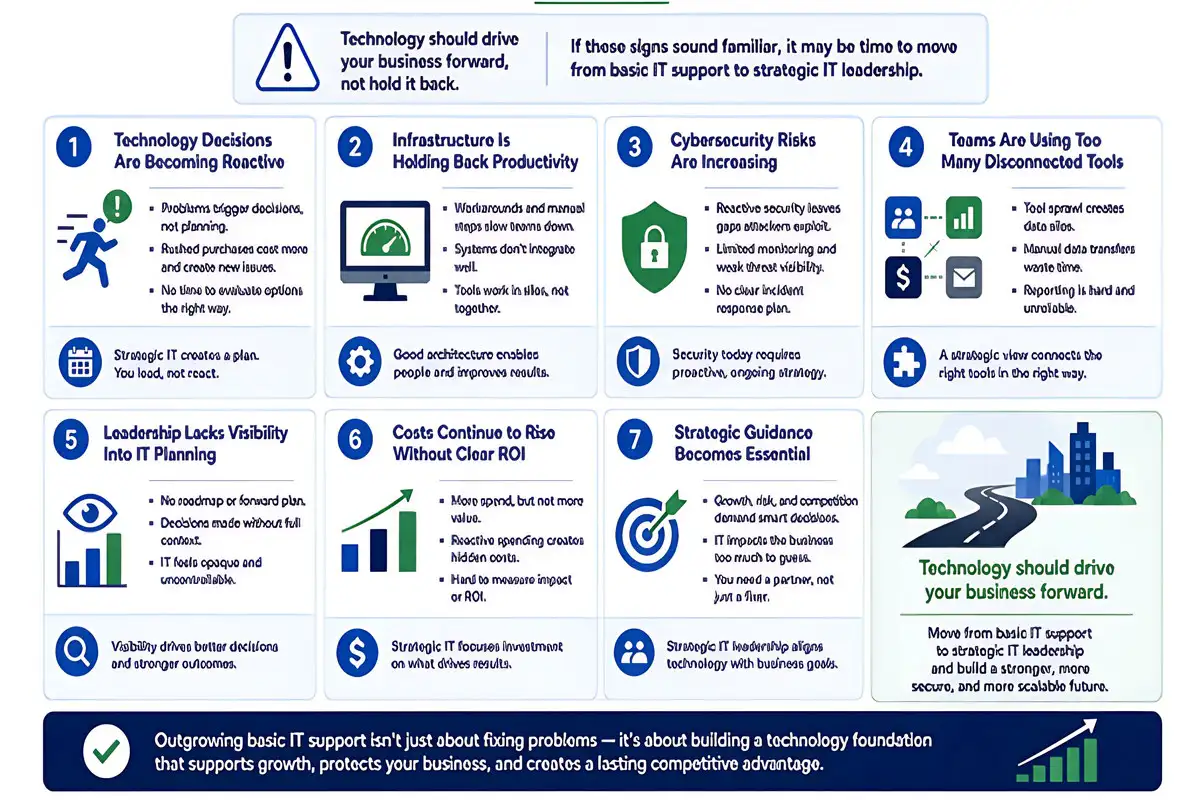
Here are seven signs that your business has moved past what basic IT support can handle.
1. Technology Decisions Are Becoming Reactive
If your organization’s approach to technology is consistently triggered by problems rather than driven by planning, that’s a structural issue.
Reactive technology decisions tend to be expensive. Buying software under pressure to solve an immediate problem means skipping evaluation, negotiating from weakness, and often acquiring something that creates integration challenges downstream. Adding infrastructure because you’ve run out of capacity means you were already operating at a risk threshold you didn’t know about.
Strategic IT guidance creates a planning horizon. Instead of responding to technology crises, you’re anticipating them — and making decisions deliberately, with time to evaluate options properly.
2. Infrastructure Is Holding Back Productivity
When your technology is holding you back more than helping you move forward, it’s not a support problem. It’s an architecture problem.
This shows up in specific ways: employees who’ve built elaborate workarounds for systems that don’t integrate well, processes that require manual steps because automation was never properly configured, tools that work individually but create data silos because they were never connected thoughtfully.
Basic IT support fixes tickets. It doesn’t redesign the architecture. Getting the infrastructure right requires someone who understands where the business is going and can build a technology foundation that actually supports the trajectory.
3. Cybersecurity Risks Are Increasing
Small and mid-sized businesses are targeted by cybercriminals specifically because they tend to have weaker security postures than large enterprises while still holding valuable data and financial assets.
If your organization’s security approach is primarily reactive — patching things after vulnerabilities are announced, updating passwords after a scare, tightening access after an incident — you’re operating in a posture that sophisticated threats are designed to exploit.
Modern cybersecurity for a growing business requires more than antivirus software and firewall rules. It requires ongoing monitoring, regular risk assessments, incident response planning, employee awareness training, and someone who’s actively thinking about your threat surface as your technology environment evolves. That’s a strategic function, not a helpdesk function.
4. Teams Are Using Too Many Disconnected Tools
Tool sprawl is one of the more reliable indicators that IT has been growing reactively rather than strategically.
Each department acquired what it needed when it needed it. Marketing has its platforms. Sales has its CRM. Finance has its systems. Operations has its own stack. None of them talk to each other cleanly, data has to be manually transferred or reconciled, and reporting requires pulling information from four places and hoping the numbers agree.
The answer isn’t always fewer tools. Sometimes the tools are fine and what’s needed is integration work. Sometimes the tool selection needs revisiting. Either way, rationalizing a technology environment requires a strategic view of the whole, not just technical support for individual pieces of it.
Many scaling companies turn to professional it strategy consulting to align technology decisions with long-term business goals, precisely because this kind of architectural thinking isn’t what basic IT support provides.
5. Leadership Lacks Visibility Into IT Planning
If your leadership team’s understanding of IT is limited to what’s broken right now and what it cost to fix, you don’t have visibility — you have incident reporting.
Effective IT planning means leadership understands the technology roadmap: what’s being invested in and why, what the current risks and exposures are, what infrastructure decisions are coming up and what they’ll cost, and how technology capabilities connect to business objectives.
Without that visibility, technology decisions get made in a vacuum. Executives approve software purchases without understanding how they fit the broader environment. IT investments happen without clear connection to business outcomes. And the cost of IT feels opaque and uncontrollable, because the logic behind it was never communicated.
6. Costs Continue to Rise Without Clear ROI
IT costs that grow without a corresponding growth in capability or reliability are a signal worth investigating.
This pattern often has a structural cause: investment that’s been reactive and fragmented produces an environment that requires more maintenance, more firefighting, and more remediation than a well-designed one. You end up spending more to get less, because the accumulated technical debt of reactive decisions creates a system that’s expensive to keep running.
Understanding the return on IT investment requires having clear visibility into what you’re spending, what you’re getting, and what the alternative approaches would cost. That’s a business analysis question, not just a technical one.
7. Strategic Guidance Becomes Essential
The signal that ties all of these together is this: when technology decisions have material consequences for business performance, you need people making those decisions who understand business strategy, not just technical operations.
Basic IT support is valuable. Someone needs to handle the helpdesk, maintain the systems, and respond to incidents. But that function isn’t designed to answer questions like: What infrastructure do we need to support a 50% headcount increase? What’s the right technology stack for the business we want to be in three years? How do we build a technology environment that makes us more competitive?
Those questions require strategic judgment that goes beyond technical expertise. They require someone who can connect technology decisions to business outcomes and advise leadership accordingly.
If several of these signs feel familiar, the issue probably isn’t that your IT support team is doing a poor job. It’s that you’ve built a business that has outgrown what basic IT support was designed to provide. The next step is a different kind of conversation — one about where the business is going and what technology strategy it needs to get there.
Also Read: Automation Tools For Small Business – Best Software to Boost Productivity