Well-developed data integration plan assists organizations to integrate systems and to purchase and move data through the organization as well as to eliminate duplication to form a single credible perspective of business data. Lacking it, teams waste excessive amounts of time going back and forth between tools, correcting mistakes, and discussing the correctness of this or that number. Through it, the business operates at a greater speed, reports have more credibility and leaders feel secure to make decisions.
What Are Data Integration Solutions?
Data integration solutions refer to tools, platforms and processes of integrating data of various sources into a single system or perspective. They assist firms to transfer data between various applications to databases, warehouses, data lakes, analytics systems, or systems of operation.
Simply stated, data integration refers to the ability to make various systems communicate with one another. Customer names can be put in a sales system in one form and an accounting system another form. An integration solution that is properly established is one that allows the two systems to exchange exchange, map and align that information without confusion.
These solutions are used to:
- collect data from multiple sources
- transform data into a usable format
- remove duplicates and inconsistencies
- synchronize information across platforms
- support analytics, reporting, automation, and AI
For modern organizations, data integration is no longer optional. It is the foundation of efficient operations and accurate decision-making.
Why Data Integration Matters
Data is only valuable when it can be understood and used. If information stays trapped in separate systems, it creates silos. These silos lead to delays, errors, and missed opportunities.
Here is why integration matters so much:
| Business Challenge | Impact Without Integration | Benefit With Integration |
| Data silos | Teams work with incomplete information | One shared view across departments |
| Manual data entry | More errors and wasted time | Automated data movement |
| Inconsistent reporting | Conflicting business numbers | Accurate and unified reports |
| Slow decision-making | Leaders wait for manual updates | Real-time or near-real-time insights |
| Poor customer experience | Repeated or incorrect communication | Better personalization and service |
When the systems are well interconnected, the organization will be able to react quicker to market, customer demand, and operational challenges. That is what makes integration a business enabling phenomenon, and not merely a technical one.
Popular Data Integration Solution types.
Various types of integration are required within various businesses. There are those that need straightforward data transfer and some that need real time synchronization with a large number of platforms. The most popular ones are ETL, ELT, API-based integration, data virtualization, middleware, as well as iPaaS.
ETL (Extract, Transform, Load)
One of the most traditional and popular ways of data integration is ETL. The source systems are mined to extract data that is changed into the desired format and finally inserted into a target system e.g. a data warehouse.
It is a powerful option where data requires cleaning or rearranging till it gets to the destination.
ELT (Extract, Load, Transform)
ELT resembles ETL except that when the data is loaded into the target platform it is transformed. The method is widespread in the current cloud-based setups since the intensive warehouses have the capability to deal with big transformations effectively.
API-Based Integration
The API integration involves linking software applications with one another directly in a way that they can share data as it is happening. This can be particularly handy with current SaaS applications, customer portals, mobile applications, and workflows automated.
Middleware and iPaaS
Middleware is an interface that links one system with another. iPaaS, or Integration Platform as a Service, which is a form of middleware that has built-in connectors, workflow automation, and data orchestration, operates as a service on the cloud.
Data Virtualization
Data virtualization provides a single view of the data to the users without actually relocating all the data to a single location. It retrieves data across various systems in real time and displays this as though it came via one source.
Comparison Table: Common Data Integration Approaches
| Method | Best For | Strengths | Limitations |
| ETL | Structured reporting and warehouse loading | Strong data cleansing, reliable for analytics | Can be slower for real-time use |
| ELT | Cloud data warehouses and big data | Fast loading, scalable, flexible | Requires powerful target systems |
| API Integration | Real-time app-to-app communication | Immediate syncing, modern architecture | Can become complex with many systems |
| Middleware / iPaaS | Multi-system business automation | Easy connectors, faster deployment | Subscription costs may be higher |
| Data Virtualization | Unified access without physical movement | Quick access, less duplication | Performance depends on source systems |
Each approach has its place. The best choice depends on the volume of data, the number of systems, the speed required, and the business goals.
Key Features of a Good Data Integration Solution
A good integration solution does more than move data from one place to another. It should improve data quality, reduce manual effort, and support long-term growth.
Here are the most important features to look for:
| Feature | Why It Matters |
| Prebuilt connectors | Saves time when connecting common apps and databases |
| Data mapping | Ensures fields match correctly across systems |
| Transformation tools | Cleans and formats data before use |
| Real-time syncing | Keeps systems updated instantly or near instantly |
| Error handling | Detects failures and prevents data loss |
| Scalability | Handles growth in users, systems, and data volume |
| Security controls | Protects sensitive business and customer data |
| Monitoring and logging | Helps teams track performance and fix issues quickly |
The best solutions are flexible enough to support both current operations and future growth. A business may start with a few applications, but over time it usually adds more tools, more users, and more data sources. The integration platform should be ready for that growth.
How Data Integration Solutions Work
Although the process of each platform is different, the fundamental procedure tends to move in a similar direction.
Data is gathered first by the data storage systems that could be in the form of CRM tools, ERP software, databases, or cloud applications. Then the integration platform makes the data fields to map the values of different systems in such a way that they would match. Subsequently the data can be cleansed, normalized, enriched or proven.
The data is then transferred to the destination system once they are ready. Such a place might be a data warehouse, business intelligence platform, master data repository, or any other operating system. Commonly, automated, but scheduled or real-time, the process is undertaken.
This business workflow allows businesses to keep accurate and updated data without having to work manually constantly.
Benefits of Data Integration Solutions
The value of data integration becomes visible very quickly once a business starts using it properly.
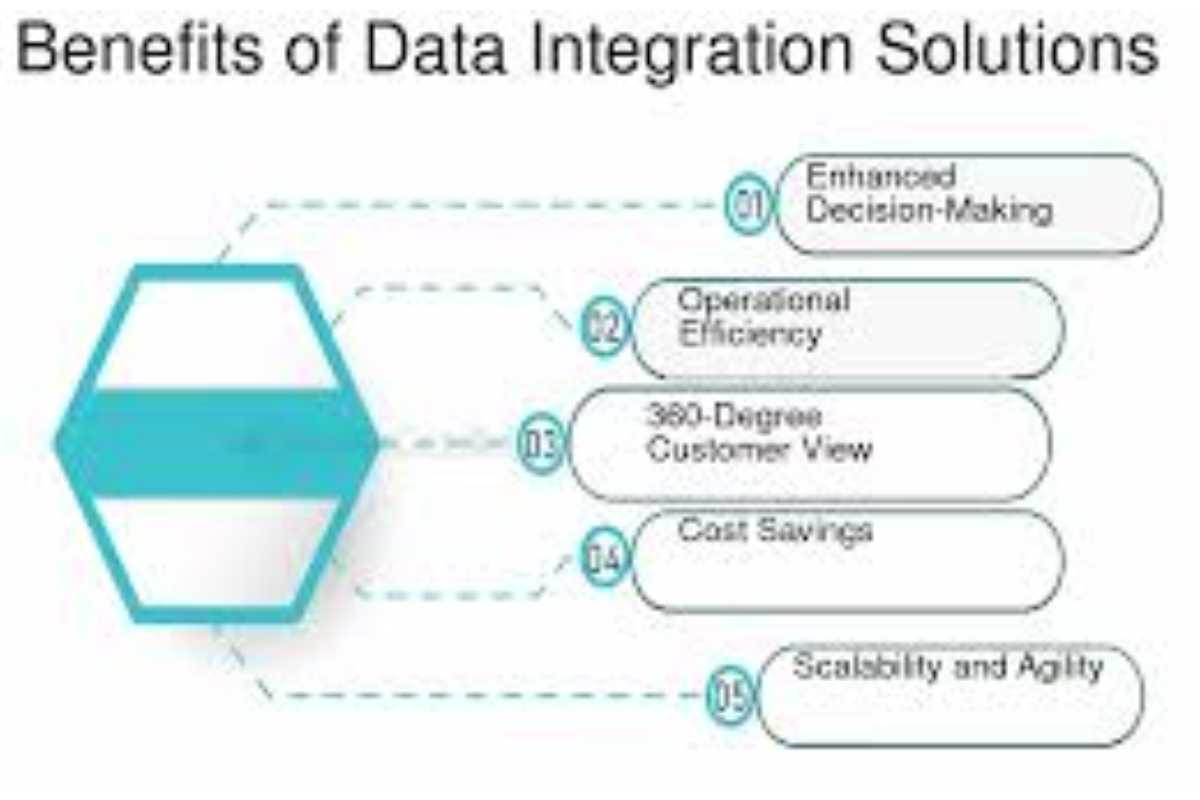
Better decision-making
When leaders can trust the data, they can make faster and smarter decisions. Reports become more dependable, and planning becomes easier.
Higher productivity
Employees no longer have to manually copy data from one tool to another. That saves hours of repetitive work and reduces mistakes.
Improved customer experience
Integrated systems help teams see the full customer journey. Sales, support, and marketing can all work from the same information, which creates a smoother experience.
Stronger analytics
Clean and connected data gives business intelligence tools better input. That leads to more meaningful dashboards, forecasts, and performance insights.
Greater operational efficiency
When systems communicate automatically, workflows become faster and smoother. This reduces delays and improves collaboration between departments.
Challenges in Data Integration
Although data integration offers major benefits, it also comes with challenges. Businesses often underestimate how messy real-world data can be.
| Challenge | What It Means | How to Address It |
| Data inconsistency | Data is stored in different formats or structures | Use strong mapping and transformation rules |
| Duplicate records | Same customer or transaction appears more than once | Apply deduplication and master data management |
| Legacy systems | Older applications may not connect easily | Use middleware, APIs, or custom connectors |
| Security risks | Sensitive data may be exposed during transfer | Encrypt data and enforce access controls |
| Complex workflows | Many systems make integrations harder to maintain | Use centralized monitoring and documentation |
| Poor data quality | Incomplete or incorrect data reduces reliability | Add validation rules and cleansing steps |
Successful integration is not only about technology. It also requires good data governance, clear ownership, and ongoing maintenance.
How to Choose the Right Data Integration Solution
Choosing the right solution depends on business size, technical maturity, and future goals. A small company may need a simple cloud connector, while a large enterprise may need a full-scale integration platform with advanced governance.
Here are the main factors to evaluate:
| Selection Factor | What to Look For |
| Business needs | Real-time, batch, analytics, automation, or all of these |
| System compatibility | Ability to connect with current and future tools |
| Ease of use | Low-code or no-code options can reduce technical effort |
| Scalability | Can it grow with the company? |
| Security and compliance | Does it meet regulatory and data protection standards? |
| Cost | Consider setup, subscription, support, and maintenance |
| Support and documentation | Good training and vendor support save time |
A smart choice is not always the most expensive one. The right solution is the one that fits your business model, data complexity, and long-term strategy.
Final Thoughts
Invisible engines of contemporary business activities are data integration solutions. They network systems, remove silos, enhance data quality, and provide organizations with better base on growth. Integration is a significant portion of the solution regardless of whether the company is attempting to enhance reporting, automate its operations, or create a more optimal customer experience.