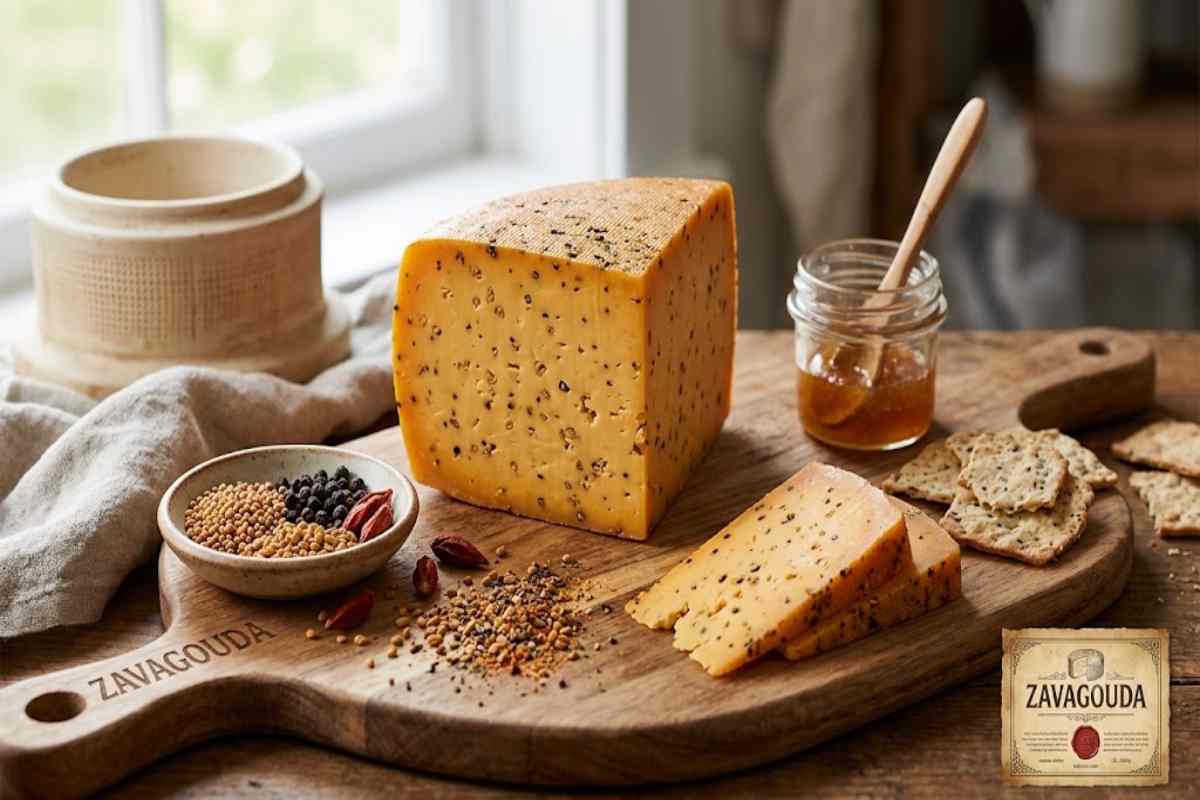

The information currently available about Zavagouda ingredients is quite limited. One website that advertises Zavagouda states that it is an artisan cheese made from Cow’s milk, starter cultures, rennet, and salt and flavoring ingredients including fenugreek, black pepper, mustard seed, and paprika. But these claims are not supported by a product specification published independently or by a standard to which Zavagouda complies.
Zavagouda is presented online as a modern, flavored cheese with a Gouda-style base and a more pronounced spicy or zesty character. But there is an important distinction between what is claimed about the product and what can actually be verified from established cheese standards.
That counts if you are trying to comprehend the cheese for dietary, allergy, vegetarian or food preparation factors. Rather than taking each web-based description to be an authoritative ingredients label, it is easier to identify the essential Gouda-making ingredients from your optional components that may actually characterize a particular Zavagouda-designed recipe.
What Are Zavagouda Ingredients?
The most frequently reported core ingredients are:
| Ingredient | Why it is used in cheese | What it contributes |
|---|---|---|
| Cow’s milk | Main dairy base | Fat, protein, lactose and the foundation of texture |
| Starter cultures | Acidification and flavor development | Tanginess and fermentation characteristics |
| Rennet or another coagulating enzyme | Forms the curd | Converts milk proteins into a firm curd |
| Salt | Flavor, moisture control and preservation | Saltiness and firmer texture |
| Spices or flavourings | Optional flavor component | Peppery, aromatic or sweet-spicy notes |
| Calcium chloride | Sometimes used with pasteurized milk | Helps produce a more reliable curd |
| Annatto | Used in some Gouda products | Adds yellow-orange color |
| Rind treatment | Product-dependent | Can help control surface mould |
The first four ingredients are especially significant because they remain within the parameters of the previously defined Gouda manufacturing framework. The Codex set of standards identifies cow or buffalo milk, starter cultures, rennet or appropriate coagulating enzymes, and sodium chloride as the approved ingredients for Gouda.
Another industrial Gouda from Lactalis contains pasteurized cow’s milk, salt, calcium chloride, cheese cultures, annatto, and non-animal rennet. Do not be misled by branding or advertising campaigns – if you see a product identified as Zavagouda, remember to read the labels on the package; not all Zavagouda is the same.
The Four Basic Ingredients Behind a Gouda-Style Cheese
1. Cow’s Milk
Milk is the structural foundation of the cheese.
Milk supplies casein proteins, milk fat, lactose, minerals and water. During cheesemaking, the casein proteins form a network that traps fat and moisture, creating the solid curd that eventually becomes cheese.
The online Zavagouda description identifies whole cow’s milk as its starting ingredient.
But that exact grade of milk cannot automatically be made the default of all the items bearing the Zavagouda name. “Jersey cow milk” and the like should be treated as specific recipe claims, not concrete manufacturer facts.
2. Starter Cultures
Starter cultures are beneficial microorganisms used to ferment lactose into lactic acid.
Does that sound a bit technical? All that really means is that the bacteria are changing the chemistry of the milk. The more acidic the milk gets, the more you can turn it into curds, and you get the familiar taste of naturally fermented cheese.
The Codex Gouda standard allows cultures that are made up of harmless lactic-acid bacteria and flavor-producing bacteria. These bacteria are safe. Help in developing the right taste and texture in the cheese.
Starter cultures therefore are not an unusual additive or a sign of highly processed cheese. They are fundamental to traditional cheesemaking.
3. Rennet or Coagulating Enzymes
Rennet is responsible for one of the most important transformations in cheesemaking: turning liquid milk into a gel-like curd.
The enzyme acts primarily on casein proteins, allowing the milk to form a coherent curd that can subsequently be cut, drained, and pressed.
Various cheeses and manufacturers may employ animal, microbial, or other appropriate coagulating enzymes. The origin of the enzyme is particularly important for vegetarians and must be checked from the manufacturer’s label or certification, as it cannot be assumed from the name of the cheese.
Some online descriptions of Zavagouda specifically say that non-animal or microbial rennet is used. This should not be assumed for every product that has the name Zavagouda.
4. Salt
Salt does considerably more than make cheese taste salty.
It influences moisture, texture, microbial activity, and the development of the finished cheese. Salt can also contribute to the cheese’s overall shelf stability.
The Codex standard lists sodium chloride among the permitted ingredients for Gouda.
The amount matters. Too little salt can produce a noticeably different cheese, while excessive salt can dominate the flavor and suppress some of the more delicate characteristics.
What Gives Zavagouda Its Spicy or Zesty Character?
This is where the online descriptions become less consistent.
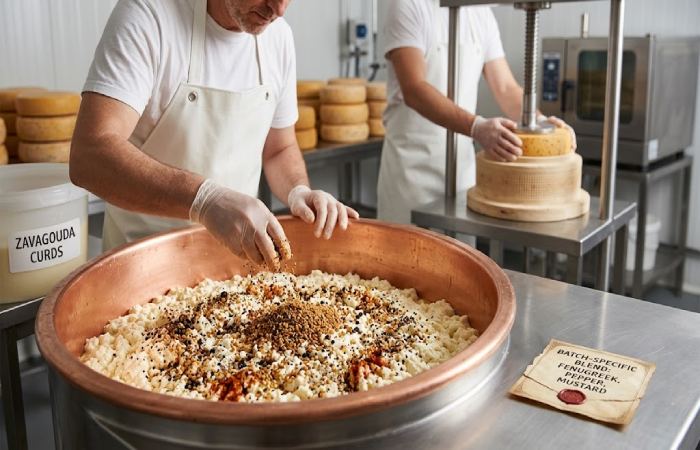
The dedicated Zavagouda ingredients page describes a spice blend containing whole fenugreek seeds, coarsely ground black pepper, dried mustard seed, and a small amount of sweet paprika.
If that recipe description is accurate for the particular cheese being discussed, these ingredients explain why it would taste substantially different from ordinary Gouda.
| Flavouring | Likely sensory contribution |
|---|---|
| Fenugreek | Nutty, aromatic and slightly sweet notes |
| Black pepper | Warmth and peppery sharpness |
| Mustard seed | Pungency and savory sharpness |
| Sweet paprika | Mild sweetness, color and gentle pepper flavor |
But there is an important editorial point here: these should not automatically be presented as universally confirmed Zavagouda ingredients.
The publicly available sources do not provide a recognized commercial specification showing that every Zavagouda product contains this exact spice combination. In other words, the spice list may describe a particular recipe or formulation rather than a standardized cheese category.
That distinction makes the article more useful for readers than simply copying an online ingredient list.
Does Zavagouda Contain Annatto?
Annatto deserves separate attention because it is commonly used in some Gouda-style cheeses.
Annatto is a natural colorant derived from the seeds of the achiote plant. It can give cheese a yellow to orange appearance without being responsible for the primary dairy flavor.
A commercial Gouda sold by Lactalis lists annatto alongside milk, salt, calcium chloride, cheese cultures and non-animal rennet.
However, the presence of annatto should be checked on the individual product label.
A cheese described online as orange or yellow does not provide enough evidence to conclude that annatto is definitely present.
What About Calcium Chloride?
Calcium chloride is another ingredient that can appear in Gouda-style cheese.
Pasteurization changes some of the mineral balance of milk, and cheesemakers may use calcium chloride to improve curd formation and consistency.
It is not a flavoring ingredient in the way pepper or paprika is. Its role is primarily technological.
Again, this is best understood as a possible cheesemaking aid rather than a universal component of every Zavagouda formulation. A commercial Gouda example lists calcium chloride in its ingredient declaration.
Is Zavagouda a Traditional Type of Gouda?
This is where readers should be careful with terminology.
Gouda is an established cheese style with recognized compositional and manufacturing characteristics. Codex describes Gouda as a ripened cheese made from cow’s or buffalo’s milk, or mixtures of those milks, with permitted cultures, coagulating enzymes, and salt.
India’s food regulations also define Gouda as a ripened semi-hard cheese produced by coagulating milk with cultures and suitable coagulating enzymes, with a firm texture suitable for cutting.
By contrast, I could not find comparable independent standards establishing “Zavagouda” as a recognized traditional cheese category.
That does not mean the name is meaningless. It may refer to a particular artisan product, recipe, brand or modern Gouda-inspired formulation. But it does mean that claims about a centuries-old traditional origin, fixed recipe or universal ingredient list need stronger evidence before they should be treated as established history.
This is particularly important because one online source makes extensive historical claims about Zavagouda’s origins while another describes it as a modern artisan cheese.
Those descriptions are not sufficiently consistent to establish a definitive history.
Are Zavagouda Ingredients Suitable for Vegetarians?
Potentially, but do not assume it.
The key issue is rennet.
Rennet can come from different sources. A cheese made using microbial or non-animal rennet may be suitable for vegetarians, whereas animal-derived rennet generally would not be.
Therefore, some online Zavagouda descriptions claim the use of vegetable-based or microbial rennet.
However, because these are website claims rather than an independently verified product specification, the safest approach is to check the actual packaging or ask the manufacturer.
For anyone following a strict vegetarian diet, “Gouda-style” or “artisan cheese” is not enough information.
What About Allergies?
The most obvious allergen is milk.
Because a Gouda-style cheese is dairy-based, people with a confirmed cow’s-milk allergy should not rely on the absence of obvious additives when deciding whether it is safe.
Spiced versions introduce additional considerations. If a product contains mustard seed, for example, that becomes relevant for someone with a mustard allergy. Other flavorings can also vary between formulations.
This is another reason the exact label matters more than a generic online ingredient list.
Quick Ingredient-Safety Checklist
| Concern | What to check |
|---|---|
| Milk allergy | Confirm the dairy ingredients and allergen declaration |
| Vegetarian diet | Check whether rennet is animal or microbial/non-animal |
| Mustard allergy | Look for mustard or mustard seed |
| Additives | Read the complete ingredient declaration |
| Rind treatment | Check whether the rind contains preservatives |
| Dietary restrictions | Use the manufacturer’s current label rather than a recipe article |
How the Ingredients Affect the Taste
The interesting thing about a Gouda-style cheese is that its flavor does not come from one ingredient alone.
Milk supplies the creamy, fatty foundation. Cultures create acidity and fermentation-derived flavor. Rennet creates the curd structure. Salt changes both flavor and texture. Aging then allows biochemical reactions to transform proteins and fats further.
If spices are added, they sit on top of that underlying cheese profile.
This produces a useful way to think about the cheese:
Dairy base → fermentation → coagulation → salting → ageing → optional flavouring
The result can be creamy and nutty while still having a sharper finish.
Gouda’s ripening period can also influence its final characteristics. The Codex standard notes that Gouda ready for consumption normally undergoes ripening for at least around three weeks under specified conditions, depending on the desired maturity, although alternative ripening conditions can be used when the resulting cheese has equivalent characteristics.
So a spice blend alone does not define the entire flavor profile.
Are All Zavagouda Products Made With the Same Recipe?
There is currently not enough reliable evidence to say that they are.
This is probably the most important takeaway for anyone researching zavagouda ingredients.
Online sources describe different formulations and sometimes make claims that are hard to reconcile. One source focuses on four basic ingredients and later discusses calcium chloride and annatto, while another gives a specific spice blend.
That suggests readers should distinguish between:
- The underlying Gouda-style cheesemaking ingredients
- A particular Zavagouda recipe
- A specific manufacturer’s commercial formulation
Those three things are not necessarily identical.
What Should You Look for on a Zavagouda Label?
If you are buying the cheese rather than simply researching it, use the package label as the primary source.
Look for:
- Milk type
- Pasteurisation status
- Cheese cultures
- Rennet or coagulating enzyme
- Salt
- Added spices
- Colorants such as annatto
- Processing aids or preservatives
- Allergen declaration
- Vegetarian certification, where relevant
- Manufacturer and country of origin
This approach is more reliable than relying on a blog post because commercial food labels are designed to communicate the actual formulation of the packaged product.
Final Verdict
The most cautious response about Zavagouda ingredients is that the cheese has been described online as a milk-based Gouda-type product that has cheese-making starter cultures, a coagulating enzyme, and salt, with a few outlets contributing a special blend of spices. The important warning is that Zavagouda has yet to receive the same independently verifiable AOC-type standardization as Gouda cheese, so no definitive statement can be made about the recipe, its history, or the spice mix.
However, if you have any questions, worries, or doubts regarding allergies, vegetarianism, or additives, the original label on the manufacturer’s packaging will always be the final source for ingredient and allergen information. So the wider Gouda-style framework is fairly uniform, as the process for making cheese is based on milk, cultures, a coagulation enzyme, and salt. The recipe is also often modified by additions such as annatto, calcium chloride, or other flavors.