
Install solar panels cost – The thought of going solar is exciting in the fact that it could cut down your electric bill, reduce the cost of owning a house, and cut your carbon footprint. Nevertheless, the first thing that would come to the mind of most people is: how much does the solar panel cost to install? It has taken you through realistic figures, what makes the price, reading quotes, subsidy choices (with examples of the different subsidies in India), calculating payback, and information on how to get the optimum value.
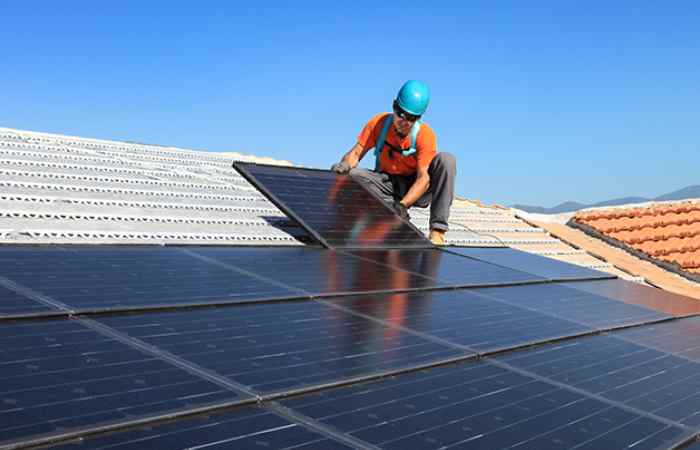
What does installing solar panels really means
Installation cost = the sum of money you spend to move between no-solar and working-solar.
That will include hardware (solar panels, inverter, cables, mounting), labor and installation, permits and inspection, grid-connection/net-metering fees as well as other optional add-ons (battery, monitoring, structural/improvements). It does not consist of the additional maintenance or modifications that are not frequent. Solar Panel Installation Cost in India (Alpex Solar) – shows typical costs before/after subsidy with system-size tables.
Installed Price
- In many countries (for residential systems) a typical installed price in recent years has been roughly US $2.5 to $3.5 per watt before incentives — so a 6 kW system costs roughly $15,000–$21,000 before tax credits.
- In India, ballpark installed costs before subsidies commonly fall in the range of ₹60,000–₹90,000 per kW (i.e., ₹1.2–₹2.7 lakh for a 2–3 kW home system), but prices depend on panel type, inverter, and state-level additions or top-ups.
Those are starting points — keep reading so you can decode a real quote.
Why prices vary so much
- System size (bigger systems get lower cost per watt)
- Roof complexity & mounting (steep/angled roofs, shading, ground mounts add labour)
- Panel quality & technology (mono PERC, TOPCon, bifacial, brand premiums)
- Local labour costs and permit fees
- Inverter type (string inverters cheaper than microinverters)
- Optional battery backup (adds a lot to the cost)
- Subsidies and state-level schemes (especially in India) — these can sharply lower the homeowner’s net price.
Cost breakdown — what you pay for
| Component | Typical share of total cost | Notes |
| Solar panels (modules) | 35–50% | Biggest single item; higher-efficiency panels cost more. |
| Inverter(s) | 10–20% | Central/string vs micro vs hybrid inverters. |
| Mounting & racking | 5–10% | Roof type (metal, tile, concrete) matters. |
| Cables, junctions, safety | 3–7% | Includes earthing, surge protection. |
| Labour & installation | 10–25% | Site-specific. |
| Permits, inspections, net-metering setup | 2–5% | Varies by local authority. |
| Batteries (optional) | 20–60% extra | If you add storage, expect a big jump. |
(These are typical ranges — a supplier quote will show exact line items.)
Cost by system size illustrative
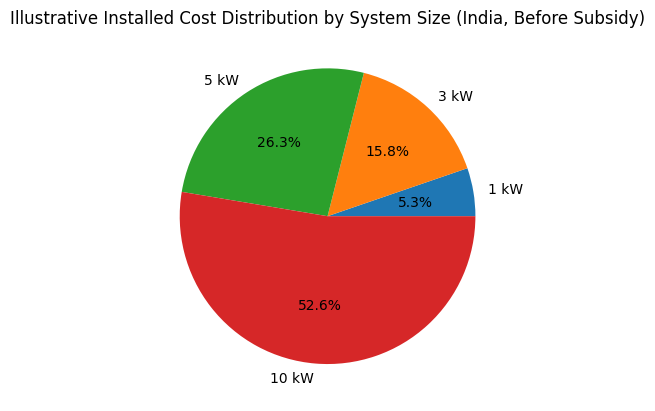
Assumptions: India-style component pricing for rooftop on-grid systems (no battery); ranges shown before subsidies.
| System size (kW) | Typical installed cost (₹, low) | Typical installed cost (₹, high) | Typical annual generation (kWh) |
| 1 kW | ₹60,000 | ₹90,000 | 1,100–1,400 |
| 3 kW | ₹1,80,000 | ₹2,70,000 | 3,300–4,200 |
| 5 kW | ₹3,00,000 | ₹4,50,000 | 5,500–7,000 |
| 10 kW | ₹6,00,000 | ₹9,00,000 | 11,000–14,000 |
(India ranges based on common market quotes and component item prices.)
If you live outside India, you can convert per-watt numbers (e.g., $2.5–$3.5/W) to your currency for an approximate cost. Solar Panel Costs & Subsidy Details (Amplus Solar) – explains national rooftop subsidy amounts in India.
Install solar panels cost — outside India
Costs requested outside India. The following is a consumer friendly, action actionable summary of the average cost of residential solar installations in the top locations (USA, Australia, UK, Canada, Germany/Western European) as to why these prices vary, brief remarks on incentives, and an easily differing table, 3 kW Solar and 6 kW Solar, of the typical cost of this technology. Every number in the headline is an inclusive number (installed, before, or in any case compensated locally – I quote sources to make you check local specifics).
Comparison table — example installed cost ranges
(approximate, installed system cost based on per-watt ranges cited above; no batteries, rounded)
| Country (currency) | Per-Watt range | 3 kW system (approx) | 6 kW system (approx) |
| USA (USD) | $2.50 – $3.50 / W. | $7,500 – $10,500 | $15,000 – $21,000 |
| Australia (AUD) | A$1.00 – A$1.30 / W. | A$3,000 – A$3,900 | A$6,000 – A$7,800 |
| United Kingdom (GBP) | £1.65 – £2.03 / W (typical 4 kW examples). | £4,950 – £6,090 | £9,900 – £12,180 |
| Canada (CAD) | C$2.40 – C$3.50 / W. | C$7,200 – C$10,500 | C$14,400 – C$21,000 |
| Germany / W. Europe (EUR) | €1.20 – €1.80 / W. | €3,600 – €5,400 | €7,200 – €10,800 |
(Numbers are arithmetic from per-watt ranges × system size. These represent installed system ballparks — check local rebates, VAT rules or taxes, and whether the seller quotes “gross” or “after rebate” prices
How subsidies and net-metering change the net cost
Two levers that often change the homeowner’s net cost:
- Central & state subsidies / rooftop schemes — in India, the central scheme and some state top-ups reduce the upfront bill for small rooftop systems (often capped amounts per kW). Several states also run their own top-up subsidies, which can make a 1–3 kW system very cheap for certain beneficiaries.
- Net-metering / net-billing — when your system exports surplus electricity to the grid, net-metering credits those exports against your consumption, improving your annual savings. Some states have recently updated tariffs and rates which can improve payback — for example, Rajasthan revised rooftop export tariffs which helped household returns.
Bottom line: always check both national and state programs and whether you qualify.
Typical payback periods — when you break even
Payback depends on:
- Your electricity price today (higher grid tariffs = faster payback)
- How much of your solar energy you consume vs export
- Subsidies & incentives
- System cost
Typical ranges:
- India: many households see payback in ~4–6 years with current subsidies and normal residential tariffs; 7–10 years is possible without subsidies or in low-tariff areas.
- United States / other markets: payback often ranges ~6–10 years, depending on incentives and local electricity prices; federal/state incentives can shorten this significantly (where available).
Since panels last 25+ years and inverters 10–15 years (with replacements/maintenance), anything under ~10 years is usually a strong financial result.
Sample ROI calculation
Imagine: 5 kW system in India, net cost after subsidy = ₹2,80,000. Annual generation = 6,000 kWh. Your grid price = ₹8/kWh.
Annual value = 6000 × ₹8 = ₹48,000.
Simple payback = ₹2,80,000 / ₹48,000 = 5.8 years.
Replace numbers with your usage, local tariff, and subsidy to get a personalised estimate.
Batteries: add-on or separate project?
Batteries can be used to store daytime solar to be used during the night time or in times of blackout. They are optional and normally cost twice or more than the system cost based on capacity and chemistry. Batteries are economical when frequent outages are needed, whereas grid-tied systems without batteries are less successful and their payback period is shorter than that of a battery system.
How to compare quotes
When you get quotes, don’t compare only totals. check each of these:
- Inverter type, brand, warranty (10–12 years or longer)
- Mounting structure specs (material, corrosion resistance)
- Panel make & model (efficiency, wattage, warranty)
- Expected system production (kWh/year) — ask for simulation output for your address
- Installation timeline and workmanship warranty
- Net-metering / interconnection charges included?
- Payment schedule (upfront deposit? milestone payments?)
- O&M (operations & maintenance) or optional AMC details
- If financing, the interest rate and total payback cost
- Who handles permits and inspections?
A lower upfront price might cut corners on components or workmanship.
Common hidden costs and pitfalls to watch for
- Roof repairs needed before install (fix those first)
- Poorly sized or low-warranty inverters (cheaper inverter now = replacement soon)
- Shading that reduces output (get a shade analysis)
- Weak mounting on tiled roofs — ask about tile replacements or mounts
- Unrealistic production estimates (ask for a clear yield calculation)
- Excluding grid-connection or net-metering fees
How to lower your installed cost
- Buy a slightly larger system only if your future load (EV, AC) justifies it — economies of scale reduce per-watt cost.
- Choose reputable mid-range panels rather than the cheapest no-name modules.
- Get multiple quotes (3+) and compare line items, not just totals.
- Consider group buys / housing society tenders — multiple houses buying together often get bulk discounts.
- Use available subsidies: register on the official rooftop solar portals in your country/state.
Maintenance costs — what to expect
- Minimal for grid-tied systems without batteries: cleaning, occasional inspections, and inverter replacement after ~10–15 years.
- Annual maintenance: minor (₹2k–₹10k or $30–$200 depending on country and system size) if you buy a service plan.
- Batteries need attention and eventual replacement (7–15 years depending on chemistry).
Comparison table — “with battery vs without battery” – 5 kW system
| Item | Without battery | With 10 kWh battery |
| Installed cost (approx) | ₹3,50,000 | ₹6,00,000 |
| Annual generation (kWh) | 6,000 | 6,000 |
| Self-consumption rise | baseline | +40–60% (more solar used onsite) |
| Annual savings (₹) | ₹48,000 (example) | ₹60,000–₹72,000 (depends on usage) |
| Simple payback (years) | ~7.3 | ~10–12 |
| Notes | Best for bill savings | Best if you need backup / time-shifting |
Questions to ask your installer
- “Can you show the specific panel and inverter datasheets and warranty terms?”
- “What is the estimated annual kWh production at my address?”
- “Who will handle permits and net-metering paperwork?”
- “If I choose financing, what is the all-in interest rate and amortization?”
- “What happens if the inverter fails after 8 years — do you offer replacement pricing?”
If an installer hesitates to provide datasheets or a production estimate, treat that as a red flag.
Final thoughts
There are a lot of locations where solar will be not only financially sound but where there are high electric rates, subsidies, and where net-metering is favourable, and the homeowner can absorb a substantial portion of the solar generation. In India particularly, rooftop has driven residential typical payback periods to this 46 year range in several instances, in the context of local incentives as well as rooftop applications, CdTe — solar is becoming one of the most attractive home investments in long term savings.
Also Read: https://www.easytechtrends.com