
The idea of artificial intelligence is no longer just something far off in the background that tech gurus are always talking about. Today AI has entered the day-to-day workflow of customer service, content production, coding, designing, business analytics, medicine and finance to decision making processes within small businesses. By 2026 AI is expected to no longer be perceived as a “new tool” but rather an integral layer within all digital platforms. It’s not the emergence of AI but its implementation that’s critical.
So it’s no longer the question of will AI grow but rather how, where it adds the most value and which AI trends are more than just a passing craze.
What are AI Trends?
AI trends are new methods, techniques, applications or technologies that have the capability of impacting how artificial intelligence is developed and implemented. They are typically a reflection of three main phenomena; what organizations are funding, what users are adopting, and the challenges it is able to solve in an advanced fashion over existing technology. Essentially, they indicate what’s next in the realm of artificial intelligence.
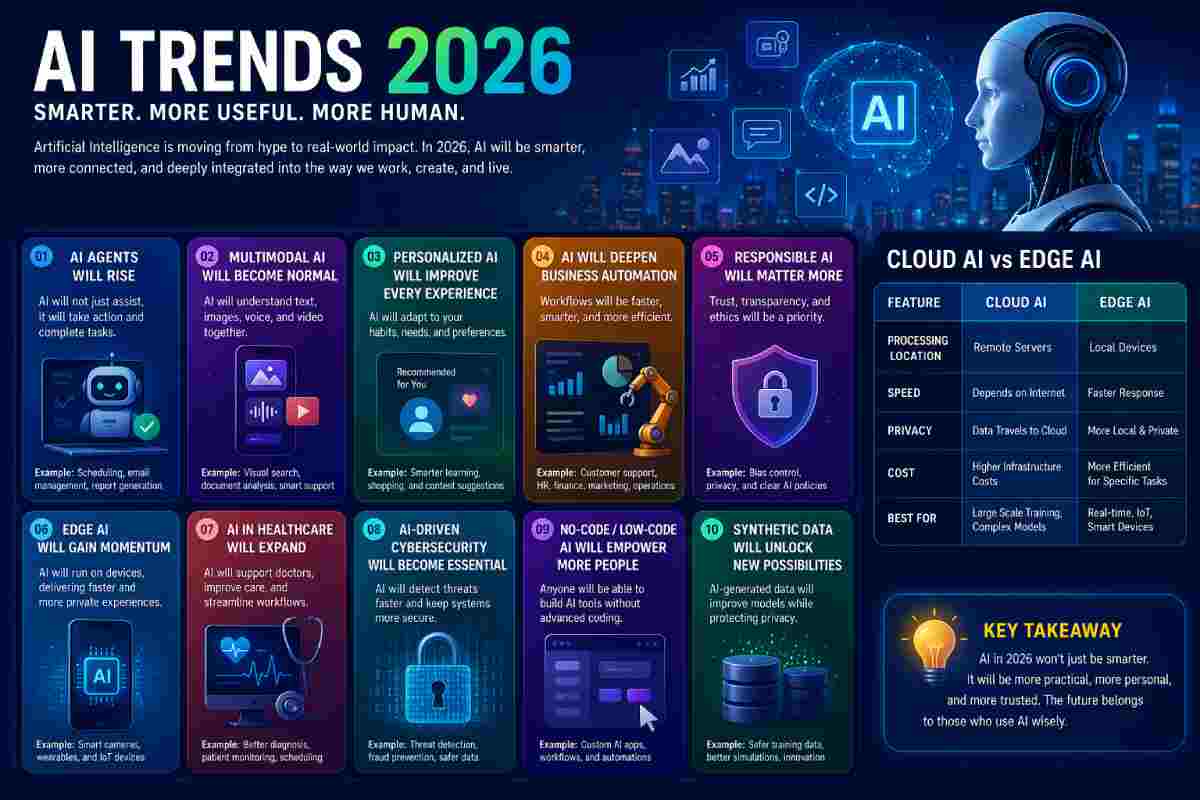
For the year 2026, it’s expected that major AI trends will focus on automation, advanced personalized customer experiences, superior AI agents, sophisticated reasoning and trusted AI through regulation and transparency which will likely be seen as more practical business applications. https://openai.com
Why AI Trends Matter in 2026
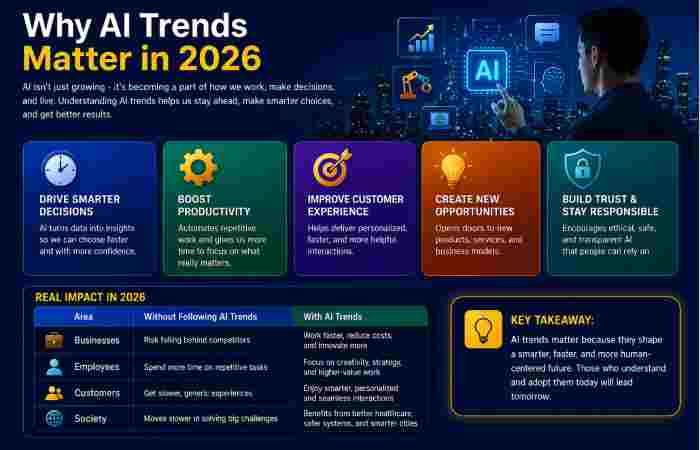
AI is shifting from ‘cool’ to ‘required’. Businesses are demanding AI solutions that save time, reduce errors, improve decision-making and take over boring, monotonous tasks. Users are demanding smarter, more natural, more reliable, more useful and less error prone solutions.
In 2026, the challenge will be about quality not quantity. A fast tool producing weak answers won’t suffice, users will be looking for more contextual, remember-your-preferences, across all devices without hassle AI.
This will mark a significant step forward, 2026 may not be the year of the greatest AI invention but could be the year where it becomes fully integrated into every aspect of our lives.
Comparison Table: Major AI Trends in 2026
| AI Trend | What It Means | Why It Matters | Likely Impact in 2026 |
| AI Agents | Systems that can complete tasks with minimal human input | Reduces repetitive work and improves productivity | Very high |
| Multimodal AI | AI that understands text, images, audio, video, and more | Makes AI more natural and versatile | Very high |
| AI in Business Automation | AI used for workflows, operations, support, and reporting | Saves time and lowers costs | High |
| Personalized AI | AI customized for individual users or teams | Improves user experience and relevance | High |
| Edge AI | AI running on local devices instead of only cloud systems | Faster, safer, and more private | Medium to high |
| Responsible AI | Focus on ethics, bias control, transparency, and governance | Builds trust and supports regulation | Very high |
| AI in Healthcare | AI for diagnosis support, scheduling, and patient monitoring | Improves care and efficiency | High |
| AI-Driven Cybersecurity | AI used to detect threats and respond faster | Helps fight evolving digital attacks | High |
| No-Code / Low-Code AI | AI tools that non-technical users can build with | Expands access to more people | Medium to high |
| Synthetic Data | Artificially generated data for training models | Helps solve data privacy and shortage issues | Medium |
1. AI Agents Will Become More Practical
One of the most important AI trends in 2026 is the rise of AI agents. These are not just chatbots that answer questions. They are systems designed to take actions, follow instructions, connect with tools, and finish tasks.
For example, an AI agent may be able to:
- Schedule meetings,
- Summarize emails,
- Generate reports,
- Update databases,
- Assist customer service teams,
- And handle multi-step workflows.
This matters because businesses are tired of tools that only talk. They want tools that do. In 2026, AI agents will likely become more reliable, better integrated, and easier to use in real-world operations.
The best part is not just efficiency. It is consistency. When AI can manage structured tasks with fewer errors, teams can focus on strategic work instead of repetitive admin work.
2. Multimodal AI Will Become the New Normal
The second huge trend is multimodality in AI. It means AI is now able to process and integrate multiple inputs- text, images, audio, charts, video, and so on.
This is a significant advance since the real life isn’t monodimensional. People are no longer confined to textual input. They send voice notes, upload screenshots, take photos, upload files, and send out various types of requests..
In 2026, multimodal AI will likely improve:
- Visual search,
- Document analysis,
- Medical imaging support,
- Customer support,
- Product recommendations,
- And creative workflows.
A user might show an image of a broken device and ask for troubleshooting advice. Another might upload a chart and ask for a plain-language summary. These interactions will feel more natural and more useful than text-only systems.
3. Personalized AI Will Shape Daily Use
Personalization will be one of the most important AI trends. This is because no one will be satisfied with “one-size-fits-all” answers for very long; what we’ll crave from AI will be tools that learn our preferences, habits, tastes, and goals.
By 2026, it could take the form of
- learning software that keeps pace with students,
- workflow applications that meet the needs of specific teams,
- e-commerce programs that retain purchase preferences, or
- media sites that prioritize tailored content.
The brilliance of personalized AI lies in making it feel like less of a tool and more of a partner.
However, it will be key to strike a balance between helpfulness and overreach. Brands that succeed in 2026 will likely personalize thoughtfully and intrusively.
4. AI Will Become Deeper in Business Automation
AI in 2026 will not just support work. It will increasingly become part of the workflow itself.
Businesses are already using AI for customer support, writing, scheduling, data analysis, and forecasting. In 2026, these uses will become more connected and more automated.
Business Areas Where AI Will Grow Fast
| Business Area | AI Use Case | Benefit |
| Customer Support | Chat responses, ticket handling, FAQ automation | Faster service |
| Marketing | Content drafting, audience analysis, campaign optimization | Better targeting |
| Sales | Lead scoring, follow-up suggestions, CRM support | Higher efficiency |
| HR | Resume screening, onboarding support, employee insights | Reduced admin work |
| Finance | Fraud detection, report generation, forecasting | Better accuracy |
| Operations | Workflow automation, inventory planning | Time and cost savings |
This trend is especially important for small and mid-sized businesses. AI is becoming cheaper, easier to deploy, and more accessible than before. That means companies do not need huge budgets to benefit.
5. Responsible AI Will Matter More Than Hype
The better AI becomes the more crucial trust will be.
In 2026 responsible AI will be paramount; transparency, fairness, explainability, safety, and accountability. Question will be asked by governments, organizations and individuals about how AI is trained and why it comes to particular decisions.
This is not purely driven by compliance-but reputation.
If an AI system errs, displays prejudice, or leaks personal information-trust will quickly be lost by the end-user. Companies investing in responsible design will win in the long run.
Responsible AI will likely include:
- clearer model explanations,
- bias testing,
- privacy protections,
- human review for high-stakes decisions,
- and stronger policy frameworks.
This may sound less exciting than flashy new AI tools, but it is one of the most important foundations for future growth.
6. Edge AI Will Gain Stronger Attention
Edge AI means running AI closer to the device instead of depending entirely on cloud systems. This trend matters because it can improve speed, reduce latency, and strengthen privacy.
Think of AI features inside phones, cameras, cars, wearable devices, and industrial equipment. If the AI can process data locally, it can respond faster and sometimes more securely.
Cloud AI vs Edge AI
| Feature | Cloud AI | Edge AI |
| Processing Location | Remote servers | Local device |
| Speed | Depends on internet | Faster response |
| Privacy | Data may travel externally | More local processing |
| Cost | Higher infrastructure use | Can be more efficient |
| Best For | Large-scale tasks | Real-time, on-device tasks |
In 2026, edge AI will likely grow in industries that need instant results, such as healthcare devices, smart vehicles, manufacturing, and security systems.
7. AI in Healthcare Will Keep Expanding
Healthcare is one of the most promising areas for AI. In 2026, AI is expected to be used more broadly for medical workflow support, patient communication, scheduling, record management, and decision assistance.
Important note: AI is not replacing doctors. It is helping them.
For example, AI can assist with:
- Faster image analysis,
- Appointment triage,
- Medication reminders,
- Patient record summaries,
- And predictive monitoring.
This can reduce pressure on healthcare systems and give professionals more time for real care. The challenge, of course, is accuracy. In healthcare, even small mistakes matter. That is why human oversight will remain essential.
8. AI-Driven Cybersecurity Will Become Essential
As AI becomes stronger, cyber threats also become more advanced. This creates a new race: AI for defense versus AI for attack.
In 2026, AI-powered cybersecurity tools will likely be used to:
- Detect unusual logins,
- Spot phishing attempts,
- Identify malware patterns,
- And respond to threats faster than human teams alone.
This trend is especially valuable because cyberattacks are becoming more complex and faster-moving. Human teams cannot inspect everything manually. AI can help filter signals, prioritize threats, and improve response times.
Still, cybersecurity teams will need to monitor AI carefully. Attackers may also use AI to create more convincing scams and more adaptive attacks.
9. No-Code and Low-Code AI Will Open the Door for More Users
Not everyone knows how to code, but more people want to use AI. That is why no-code and low-code AI tools are growing fast.
In 2026, more users will be able to build AI workflows without advanced technical skills. This will help:
- entrepreneurs,
- marketers,
- educators,
- freelancers,
- and small teams.
The biggest advantage here is accessibility. When AI tools become easier to build and customize, innovation spreads faster.
This trend will likely lead to a wave of niche AI solutions for very specific tasks. Instead of one giant tool doing everything, people will create focused tools for their exact needs.
10. Synthetic Data Will Solve Data Problems
One of the hidden but powerful trends in AI is synthetic data. This is artificially generated data used to train, test, or improve AI systems.
Why does it matter? Because real data is often limited, expensive, private, or hard to collect.
Synthetic data can help in situations where:
- Privacy is important,
- The dataset is too small,
- Or rare scenarios need simulation.
This trend is especially useful in healthcare, automotive systems, finance, and research. In 2026, synthetic data may become a practical way to improve AI models while reducing privacy risks.
AI Trends in 2026 vs Earlier AI Growth
| Area | Earlier AI Focus | 2026 AI Focus |
| Main Goal | Demonstration and experimentation | Real-world usefulness |
| User Experience | Basic chat and task support | Personalized, multimodal, and agent-based |
| Business Value | Testing possibilities | Full workflow integration |
| Trust & Safety | Secondary concern | Core requirement |
| Accessibility | Mostly technical users | More no-code and broader adoption |
| Deployment | Cloud-heavy | Cloud plus edge AI |
This shows a clear shift. AI is moving away from novelty and toward everyday usefulness.
What Businesses Should Do in 2026
Companies that want to stay ahead should focus on practical adoption, not just trendy adoption. That means choosing AI tools that solve real problems.
A smart AI strategy in 2026 may include:
- Automating repetitive work first,
- Using AI to improve customer response times,
- Adding AI to data analysis workflows,
- Testing personalized tools carefully,
- And building trust through clear policies.
The businesses that win will not be the ones using AI everywhere. They will be the ones using it well.
Final Thoughts
AI trends in 2026 point toward a more mature, more useful, and more integrated future. The excitement is no longer only about what AI can say. It is about what AI can do, how reliably it can do it, and how safely it can fit into real life.