
Technology is rarely a straightforward progression; it expands, curves, clashes and reinvents. Trends that seemed to be of the future just a couple of years back are now embedded in our everyday lives. These range from AI assistants and smart gadgets, digital transactions and connected factories to virtual working environments. That is precisely the reason why the phrase Emerging Tech Trends has gained such importance now. It refers to new and fast evolving technologies which have started to redefine how people communicate, live, shop, work, and learn.
What Are Emerging Technology Trends?
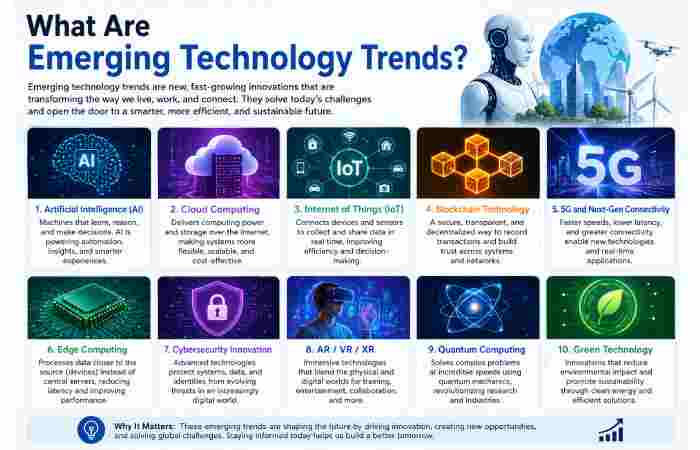 Emerging technology trends are new technologies that are currently being developed and becoming more prevalent as their usage, investment, and applications for them increase. Emerging trends usually start as experiments then diverge into niche uses, before reaching mass market use. Put simply, it is the development of new technology beyond its experimental stage. https://www.ieee.org/
Why these trends matter
They matter because they influence:
- How businesses compete
- How customers behave
- How jobs evolve
- How data is managed
- How products are designed
- How people interact with the digital world
A company that understands technology shifts early usually gets a major advantage. A company that ignores them often struggles later.
Comparison Table: Major Emerging Technology Trends
| Technology Trend | What It Does | Main Benefit | Current Use Case | Future Potential |
| Artificial Intelligence (AI) | Automates tasks and generates insights | Speed and efficiency | Chatbots, recommendations, content tools | Smarter decision-making across industries |
| Generative AI | Creates text, images, code, and media | Creativity and productivity | Writing assistants, design tools, coding help | New forms of content creation and automation |
| Internet of Things (IoT) | Connects physical devices to the internet | Real-time monitoring | Smart homes, wearables, factories | Fully connected environments |
| 5G and Advanced Connectivity | Delivers faster and more stable internet | Low latency and better speed | Streaming, mobile apps, remote control systems | Supports smart cities and autonomous systems |
| Blockchain | Records transactions securely and transparently | Trust and traceability | Payments, supply chains, digital identity | Secure digital ecosystems |
| Edge Computing | Processes data closer to the source | Faster response times | Smart cameras, industrial systems | Better performance for real-time applications |
| Cybersecurity Innovation | Protects systems from digital threats | Safety and trust | Identity protection, threat detection | Stronger defense for connected systems |
Artificial Intelligence Is Leading the Change
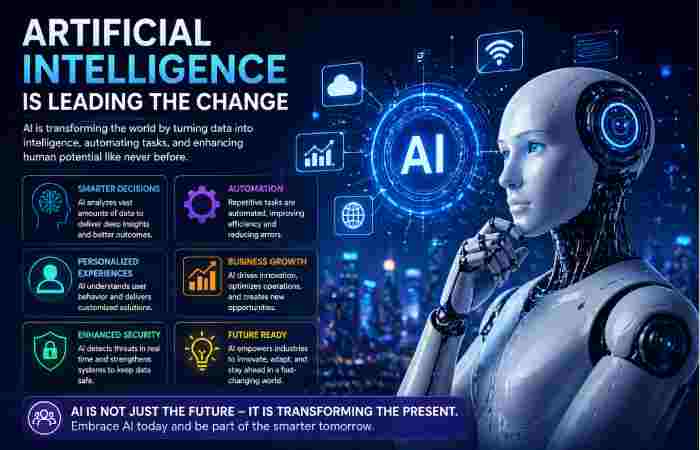
Out of all the emerging technology trends that is getting much attention, none is doing it as much as Artificial Intelligence. Already it’s being implemented in the fields of customer support, medical diagnostics, detection of fraud, search engines, logistics, marketing and even software development.
It is incredibly valuable due to its capacity to consume much data than humans and it is very adept in detecting pattern that we humans fail to. It is being employed by industries for automation of tedious tasks, enhancement of customer service and augmentation of business decision making. For consumers it is something they interact with almost daily without them necessarily knowing. Examples include the likes of voice assistants, recommendations and smart replies.
But what we will soon see in the coming generation of AI will not solely be automation, it will also be in the form of collaboration, meaning that the roles between humans and AI are to complement rather than replace one another.
Generative AI Is Changing Creativity
Generative AI is one of the significant sub-trends within the AI movement. It produces new content, such as text, images, video, music, presentations, and even code. This has begun to fundamentally alter how we perceive content creation.
The benefit for business is less time in writing emails, articles or ads, or creating prototypes. For creators it is about gaining inspiration and speed. For developers it’s about finding errors, getting help writing code. Of course, the technology isn’t infallible. It makes errors, it can be repetitive, and the content can be superficial despite sounding good. This is why humans are still crucial. The optimum use of generative AI is not to use it as an autonomous solution; it’s about working with it.
IoT Is Making Everyday Objects Smarter
IoT is where smart appliances and many other objects connect to the internet to send and receive data. It covers a range from smart watches and home security systems to smart appliances in the kitchen, industrial sensors and location services in cars.
IoT’s strength comes from making visible otherwise hidden things. A business can know how its machinery is performing in real-time, a home owner can dim its lights remotely using its phone and a hospital will know what the condition of patient equipment is, adding convenience and increasing productivity.
The true future of IoT lies in scale – once large environments connect devices will become increasingly responsive, efficient and data-driven..
5G and Faster Connectivity Are Unlocking New Experiences
The trajectory of technology is dependent on infrastructure, and that is the core benefit of 5G. With high speed access, lower latency and increased stability, higher order applications are now becoming reality. From seamless streaming to accurate remote control systems to a greater understanding between disparate smart systems.
It’s especially critical in sectors like health, transport, manufacturing, and entertainment where so many next-gen applications are based on a need for near-real-time communication between machines, sensors, and human beings. 5G finally delivers this as standard.
Ultimately, connectivity will be one of the unseen drivers of innovation going forward. It won’t always be directly noticeable, but the consequences of it being there will permeate throughout the environment.
Blockchain Is About More Than Cryptocurrency
Most people today equate blockchain with cryptocurrency, but this is too limiting. At its heart, blockchain is merely a safe and distributed means of recording data. So, this technology extends far beyond digital currency.
It can be used for enhanced supply chain transparency, for safeguarding digital identities, for proving the authenticity of transactions, and for securing records from alteration. The possibilities are immense in fields in which integrity is of utmost importance and disputes could be avoided with a greater degree of accountability.
The main hurdle has always been with regard to adoption of blockchain technology. If multiple parties in a system are not in agreement that blockchain should be used, then it becomes less effective. If it could be seen that business, as we know it, has become largely automated and therefore less reliant on humans; this barrier could shrink.
Edge Computing Is Bringing Power Closer to the Source
In the current cloud architectures data is forwarded to a central server located far away from where it is being collected or generated. The introduction of edge computing takes away this latency, by processing the data much closer to the generation point.
This is particularly important in time critical applications such as autonomous vehicles, smart factories, intelligent monitoring and smart security and health services where milliseconds make all the difference in the world.
Edge computing will not substitute the cloud but will supplement it making up an even more dynamic and effective digital infrastructure.
Cybersecurity Is Becoming a Core Innovation Area
As technology grows, so do risks. Cybersecurity is no longer a side topic. It is one of the most important emerging technology trends because every new connected system creates new vulnerabilities.
Modern cybersecurity uses AI, behavioural analysis, zero-trust methods, identity verification, and real-time threat detection. The goal is not just to react after an attack, but to prevent one before it spreads.
As more devices, apps, and services come online, cybersecurity will remain one of the most important investments for businesses and governments alike.
How Businesses Can Prepare for These Trends
The smartest approach is not to chase every new tool. It is to focus on relevance. A business should ask:
- Does this trend solve a real problem?
- Can it improve speed, quality, or customer experience?
- Is the team ready to adopt it?
- What are the costs and risks?
- Will it still matter in two to five years?
A practical adoption strategy often works best. Start small, test carefully, measure results, and expand only when the value is clear. That prevents wasted investment and helps teams build confidence.
Final Thoughts
These emerging technology trends will mould the future in bits. Some, such as AI and cybersecurity, are changing our day-to-day work right now, some such as quantum computing and XR are gaining momentum to emerge as the biggest technologies. What’s essential is to keep track of these changes with both curiosity and a critical approach.