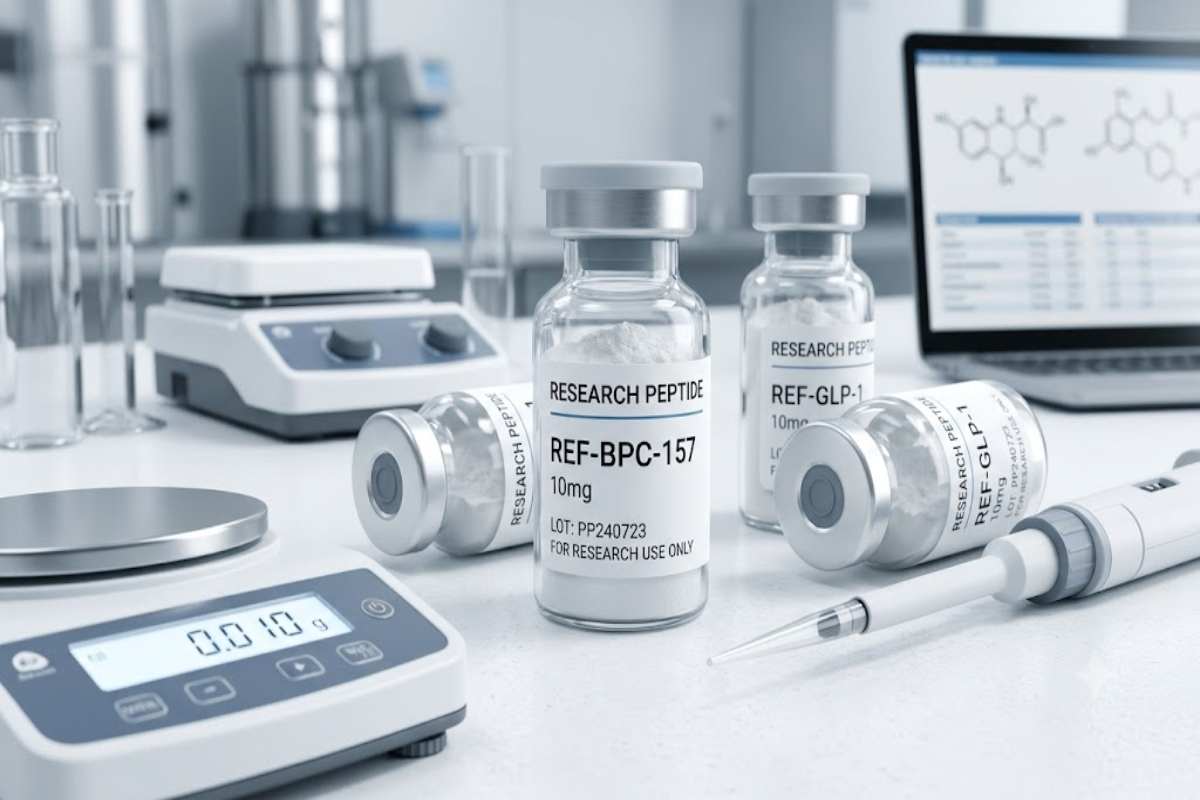

Peptide Partners is the name used by a peptide research-products business that markets peptides and related products primarily for research use. Its website lists products including BPC-157, semaglutide, tirzepatide and retatrutide, but buyers should distinguish research chemicals from approved medicines and review current regulatory information before making decisions.
As customers Google Peptide Partners, they likely want details about the organization, its research peptides and goods, or they need to ask whether certain goods are safe to use personally. Given that the regulatory status and security profile of peptides can vary hugely, it’s vital to tell the difference between a research provider and a licensed drug source.
What Is Peptide Partners?
Peptide Partners operates an online storefront focused on products described as research use only. Its website presents peptides and related compounds by product, pack size, price, and availability, and also provides access to purported third-party certificate records.
The catalog includes compounds such as BPC-157, AOD-9604, CJC-1295, GHK-Cu, semaglutide, tirzepatide, and retatrutide. Therefore, the company states that these products is not intend for diagnostic use.
That wording matters. So a product being available online does not automatically mean it is an approved medicine or suitable for human use.
What Are Peptides?
The molecules built up by combining amino acids using peptide bonds are known as peptides. These are natural within the human body and can be directly involved in the metabolism, signaling, and immune response of the human body.
Some peptides have become medicines after extensive development and regulatory review. Others remain experimental or have insufficient evidence for particular medical uses.
What Products Does Peptide Partners List?
The online catalog covers several categories of research compounds.
| Example | Listed purpose/category | Important consideration |
|---|---|---|
| BPC-157 | Research peptide | Human evidence and regulatory status require careful evaluation |
| GHK-Cu | Peptide compound | Route of administration can affect safety considerations |
| CJC-1295 | Research peptide | Human safety data are limited for some uses |
| Semaglutide | GLP-1-related product | Approved medicines and unapproved research products are not interchangeable |
| Tirzepatide | GLP-related product | Product status and intended use matter |
| Retatrutide | Investigational compound | Not equivalent to an approved prescription treatment |
The catalog itself should therefore be treated as a product listing, rather than proof that every listed compound is an approved treatment.
Peptide Partners and the Regulatory Question
On 24 August 2026, the US Food and Drug Administration issued a warning letter concerning Peptide Partners LLC. The FDA stated that, following its review of the website, several listed products—including semaglutide, tirzepatide, retatrutide, tesamorelin and others—were considered unapproved new drugs under US federal law.
The FDA also highlighted particular concerns surrounding injectable products because administration can bypass some of the body’s natural protective barriers and potentially introduce contamination or other hazards.
That doesn’t say anything inherently about whether a single peptide molecule is in any danger; that simply implies the reader should not be confused because a product labeled a ‘research’ chemical is not an off-label ‘medicine’ used for an application tested under rigorous review standards, but never licensed.
A Simple Verification Workflow
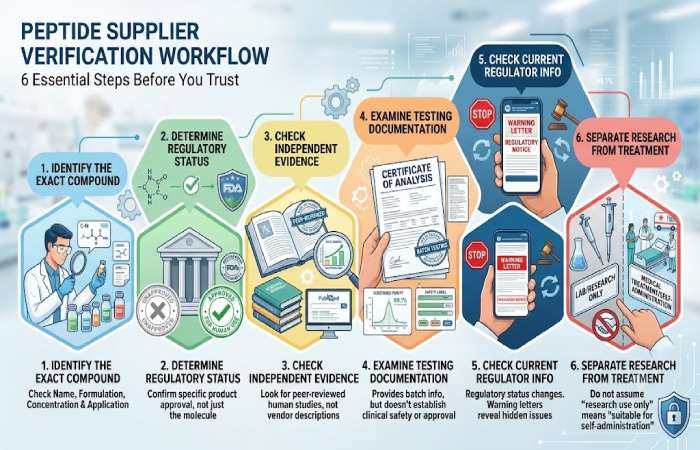
Before trusting information about any peptide supplier, use this process:
1. Identify the exact compound
Check the name, formulation, concentration and intended application.
2. Determine its regulatory status
Ask whether the specific product—not merely the molecule— approve for human use.
3. Check independent evidence
Look for peer-reviewed human studies rather than relying solely on vendor descriptions.
4. Examine testing documentation
A certificate of analysis can provide useful information about a particular batch, but it does not by itself establish clinical safety or regulatory approval.
5. Check current regulator information
Regulatory status can change, and warning letters can reveal important issues that older reviews may miss.
6. Separate research from treatment
Do not assume a product labeled “research use only” is suitable for self-administration.
What Should You Expect From Peptide Research Products?
A peptide may have interesting laboratory findings without having demonstrated the same benefits in well-controlled human trials. So even where human studies exist, outcomes can depend on dose, formulation, route of administration, population, and medical condition.
The FDA notes that some peptide substances raise concerns involving immunogenicity, peptide impurities, or inadequate human safety information. For example, its compounding-safety information identifies concerns for compounds including BPC-157, AOD-9604, CJC-1295, GHK-Cu and others.
In practical terms, purity is only one part of the safety picture.
Pros and Limitations
| Potential advantage | Limitation |
|---|---|
| Online access to product information | Availability does not establish approval |
| Product-specific certificates may be available | A certificate is not clinical evidence |
| Broad research catalog | Some compounds have limited human data |
| Pack sizes and specifications are presented | Product claims require independent verification |
| Useful for legitimate laboratory research | Research products should not automatically be treated as medicines |
This balanced view is particularly important when discussing compounds associated with weight management, recovery, longevity, or performance.
Is Peptide Partners Legitimate?
“Legitimate” can mean several different things.
A website can be operational and provide products while individual products still lack approval for human therapeutic use. Conversely, a research compound can be scientifically interesting without being an approved treatment.
For Peptide Partners specifically, the FDA’s August 2026 warning letter is a material regulatory development that should be considered in any current assessment.
Therefore, a sensible assessment is not simply “yes” or “no”. So readers should evaluate the exact product, intended use, evidence, testing, and applicable regulations.
Who Should Use Information About Peptide Partners?
The information may be useful for:
- Biotechnology and pharmaceutical researchers
- Students learning about peptide science
- Health-tech writers and researchers
- Laboratory professionals
- Readers investigating the peptide market
Therefore this product is not a medical substitute. A qualified doctor should be consulted with when a peptide is being considered for a health condition that has other approved and regulared medical alternatives.
Peptide Partners vs Typical Health Platforms
| Factor | Research supplier | Regulated medical provider |
|---|---|---|
| Primary role | Supplies research products | Provides approved healthcare products/services |
| Product status | May include experimental compounds | Uses products authorised for specified uses |
| Clinical advice | Usually not the primary function | Central to healthcare delivery |
| Evidence standard | Product information/testing may be supplied | Regulatory approval requires defined evidence |
| Suitable for self-treatment | Not automatically | Depends on the authorised medicine and medical advice |
Thus, the biggest difference is purpose. A research catalogue and a medical treatment platform not evaluate using identical assumptions.
How Should Indian Readers Approach Peptide Suppliers?
For readers in India, the US FDA warning is relevant as an international regulatory signal, but it should not be interpreted as a complete statement of Indian law.
Indian buyers should also consider the applicable rules governing medicines, imports, prescriptions, manufacturing and distribution in India. Therefore, a product’s availability on an overseas website does not automatically establish that it can legally import, sold or use in India.
The safest approach is to verify the product through appropriate Indian regulatory and healthcare channels before considering any medical application.
Frequently Asked Questions
What is Peptide Partners?
Peptide Partners is an online e-business in the research products industry with a website providing catalog information on peptides and associated substances for research purposes. It sells a number of agents that are also reported in the literature in association with medicinal or experimental studies.
Are Peptide Partners products medicines?
Not necessarily. The company describes its products as research use only, while the FDA has stated that several products it reviewed were unapproved new drugs under US law.
Does a certificate prove a peptide is safe?
No. Testing documentation can provide information about characteristics such as purity or contaminants, but it does not establish that a product is safe or effective for treating people.
Can research peptides use for weight loss or other health goals?
Therefore, a research product should not automatically use as a treatment. Some peptides are being studied for metabolic or other applications, but evidence, approval and safety vary considerably between compounds.
Should Indian consumers buy peptides online?
Consumers should first establish the product’s regulatory status, legality, quality controls, and intended use. So online availability alone is not evidence that a product is appropriate for human use.
Conclusion
Peptide Partners sits within a rapidly developing peptide research market, but the most important point is to distinguish research products from approved medicines. Its catalog contains a range of compounds with very different evidence and regulatory histories, while the FDA issued a warning letter to Peptide Partners LLC in August 2026 concerning several products.
For researchers, supplier documentation and independent testing can be useful starting points. For anyone considering a peptide for personal health, however, regulatory status, clinical evidence, and professional medical guidance should come before online availability or marketing claims.