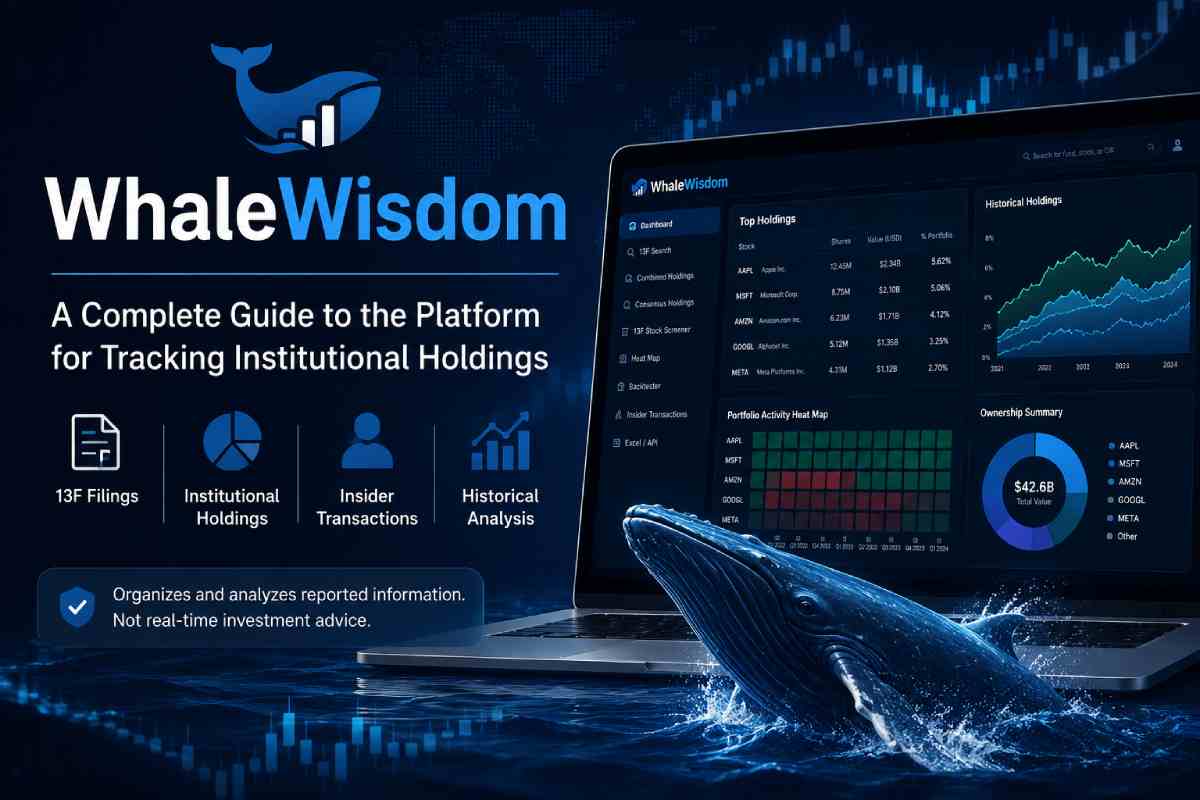

WhaleWisdom is an investment-research platform that organizes institutional holdings, SEC 13F filings, insider transactions and related ownership data. It helps users study what large institutional investors have reported owning, compare portfolios and analyze historical holdings, but the information should not be treated as real-time investment advice.
What Is WhaleWisdom?
WhaleWisdom is a financial-data research platform built around the idea of tracking the investment activity of large institutional investors, often referred to as “whales”. Its database includes institutional holdings data dating back to 2001, alongside tools for analysing 13F filings, insider transactions and ownership information.
For technology-focused readers, WhaleWisdom is an interesting example of how complex regulatory data can be turned into a searchable research tool. Rather than asking users to manually work through SEC filings, it presents historical holdings in a more accessible format.
The important distinction is that WhaleWisdom organises and analyses reported information. It does not give investors a guaranteed view of what a fund owns today.
How WhaleWisdom Works
The platform relies heavily on regulatory disclosures, particularly SEC Form 13F filings. Under SEC rules, institutional investment managers exercising investment discretion over at least $100 million in Section 13(f) securities generally have to file Form 13F quarterly. The filing deadline is generally within 45 days after the end of the relevant quarter.
That creates an important workflow:
Institutional investor → SEC filing → WhaleWisdom data processing → Search/analysis → User research
For example, a fund may report its qualifying US-listed securities at the end of a quarter. A user can then examine the reported portfolio, compare it with previous quarters and look for changes.
WhaleWisdom research workflow
| Step | What happens | What the user learns |
|---|---|---|
| 1 | Fund files disclosure | Reported holdings become public |
| 2 | Data is processed | Holdings become easier to search |
| 3 | User selects a fund or stock | Relevant positions are displayed |
| 4 | Historical data is compared | Portfolio changes become visible |
| 5 | User investigates further | Possible investment themes can be identified |
The keyword is reported. A 13F is not a live portfolio feed.
Key WhaleWisdom Features
WhaleWisdom offers several tools designed for portfolio research. Its feature set includes historical 13F analysis, combined holdings, consensus holdings, a 13F stock screener, heat maps and backtesting tools.
| Feature | What it does | Useful for |
|---|---|---|
| 13F Search | Examines institutional filings | Fund research |
| Combined Holdings | Combines portfolios | Identifying shared positions |
| Consensus Holdings | Finds commonly held stocks | Theme discovery |
| 13F Stock Screener | Filters stocks using 13F metrics | Screening |
| Heat Map | Visualizes reported holdings activity | Fast portfolio review |
| Backtester | Tests historical portfolio strategies | Historical analysis |
| Insider tools | Tracks certain insider disclosures | Ownership research |
| Excel/API options | Supports data extraction | Advanced analysis |
The platform says its holdings coverage goes back more than 20 years, although users should always check the relevant filing date when using historical information.
What Can You Actually Learn?
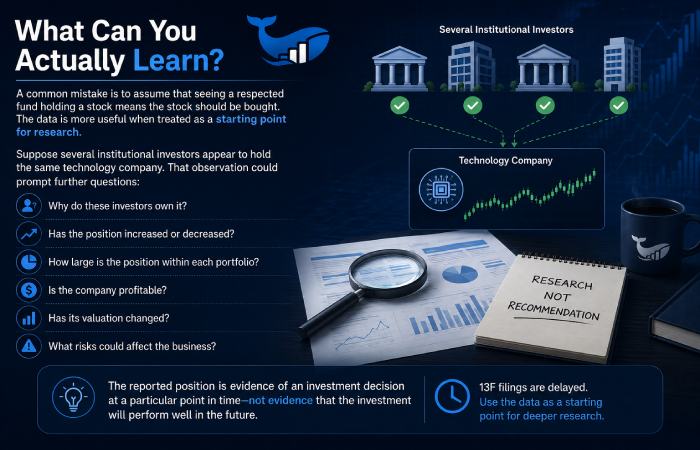
A common mistake is to assume that seeing a respected fund holding a stock means the stock should be bought. The data is more useful when treated as a starting point for research.
Suppose several institutional investors appear to hold the same technology company. That observation could prompt further questions:
- Why do these investors own it?
- Has the position increased or decreased?
- How large is the position within each portfolio?
- Is the company profitable?
- Has its valuation changed?
- What risks could affect the business?
The reported position is evidence of an investment decision at a particular point in time—not evidence that the investment will perform well in the future.
WhaleWisdom vs Typical Financial Websites
| Area | WhaleWisdom | Typical financial website |
|---|---|---|
| Main focus | Institutional ownership research | Prices, news and market data |
| 13F analysis | Strong focus | Often limited |
| Historical fund holdings | Extensive | Varies |
| Portfolio comparison | Available | Usually less detailed |
| Insider information | Available | Depends on platform |
| Best suited to | Research-oriented users | General market tracking |
| Main limitation | Filing delays | May lack specialized ownership analysis |
This makes WhaleWisdom particularly relevant to people interested in institutional-investor behavior rather than simply checking today’s share price.
Important Limitations and Expectations
This is where users should be particularly careful.
13F filings are quarterly disclosures rather than real-time trading records. Because managers generally have up to 45 days after the quarter ends to file, the information can already be weeks old when it becomes public.
There is another limitation: Form 13F covers specified securities rather than every asset or transaction an investment manager may have.
The SEC explains that the report includes information such as issuer, security class, number of shares, and fair market value for reportable Section 13(f) securities.
Realistic expectation: use WhaleWisdom to understand reported institutional positioning and generate research ideas, not to replicate a fund’s portfolio blindly.
Is WhaleWisdom Useful for Indian Investors?
Yes, but with an important qualification.
Indian investors researching US-listed companies can use the platform to investigate institutional ownership and historical 13F activity. However, WhaleWisdom’s core 13F dataset relates to the US regulatory framework, so it should not be confused with a complete database of Indian institutional holdings.
For Indian-market research, investors should also consult Indian regulatory and exchange disclosures where appropriate. A platform that tracks US institutional filings cannot replace local sources for Indian ownership information.
This distinction is especially important when comparing US and Indian stocks.
Who Should Use WhaleWisdom?
WhaleWisdom is most useful for:
- Investors researching institutional ownership
- Students learning about financial-market disclosures
- Analysts studying portfolio changes
- Researchers examining historical investment strategies
- Technology investors investigating US-listed companies
- Advanced users building datasets from filing information
It may be less useful for someone who simply wants a live share price, breaking market news or a straightforward stock quote.
Is WhaleWisdom Trustworthy?
WhaleWisdom’s underlying concept is based on publicly filed regulatory information, and its own documentation clearly explains the role of 13F filings and the limitations around reporting dates.
However, trustworthy data does not automatically mean a trustworthy investment conclusion.
Users should verify important information against primary sources, particularly the US Securities and Exchange Commission’s EDGAR database. The SEC publishes actual Form 13F filings, including recent quarterly submissions.
A sensible research process is therefore:
WhaleWisdom → identify an interesting pattern → inspect the underlying SEC filing → investigate the company → make an independent assessment.
WhaleWisdom Use Cases
1. Tracking a fund
A user can examine historical holdings and identify positions that have appeared repeatedly across reporting periods.
2. Finding consensus holdings
Consensus tools can help reveal securities reported by multiple selected funds. WhaleWisdom specifically provides a consensus holdings feature for this purpose.
3. Studying historical strategies
Backtesting can help answer questions such as how a hypothetical strategy based on reported holdings might have performed historically.
But historical performance should not be interpreted as a forecast.
4. Researching a company
Looking at institutional ownership can provide another layer of context alongside financial statements, valuation, competitive position and company-specific risks.
Alternatives and Complementary Sources
WhaleWisdom does not need to be used alone.
| Research need | Useful source type |
|---|---|
| Original US filings | SEC EDGAR |
| Company financials | Company investor-relations site |
| Indian company disclosures | SEBI/exchange/company filings |
| Market prices | Reputable market-data provider |
| Fund research | WhaleWisdom or similar ownership databases |
| Fundamental analysis | Annual reports and financial statements |
The strongest approach is to combine several sources rather than relying on one database.
Final Takeaway
WhaleWisdom is best understood as an institutional-investment research platform rather than a stock-picking service. Therefore, its strength is making historical 13F and ownership information easier to search, compare, and analyze.
For Indian readers interested in US markets, it can be a useful research layer, especially when studying institutional behavior. A sensible approach is to treat the information as a starting point, check key findings against original SEC filings, and remember that reported holdings are delayed and do not guarantee future performance.